Type 2 Friendly Free

7-Day Diabetic Meal Plan

Even carbohydrate portions, high fiber and protein at every meal, an ordinary week of food built to keep blood glucose steadier.

~1,640
Daily calories
~115 g
Protein/day
~34 g
Fiber/day
~40–50 g
Carbs/meal

What this plan actually does

There is no single “diabetic diet”. What most guidance converges on is a pattern: carbohydrate kept moderate and consistent from meal to meal, fiber pushed high, protein present every time you eat, and most carbohydrate arriving in intact forms, whole grains, legumes, whole fruit, rather than as flour, juice or sugar.

This week is built on that pattern. Each main meal lands near 40–50 g of carbohydrate, always alongside protein and fiber, which blunts how fast glucose arrives in the blood. Nothing is forbidden and nothing is exotic; it is ordinary food in deliberate proportions.

It is general information, not a treatment plan. Diabetes is managed with a clinician, and the single most important thing on this page is the medication note below. If you take insulin or a sulfonylurea, changing how much carbohydrate you eat without telling your prescriber can drop your blood glucose too low.

A good fit if

  • Adults with type 2 diabetes looking for a practical weekly structure
  • Anyone told they have prediabetes or raised HbA1c
  • People who want even carbohydrate portions rather than carb elimination
  • Households cooking one meal for everyone, none of this reads as “diet food”
  • Anyone whose glucose spikes most after breakfast and evening meals

Talk to a doctor first if

  • Type 1 diabetes without dietitian input on carbohydrate counting and dosing
  • Anyone on insulin or sulfonylureas who has not spoken to their prescriber first
  • Anyone pregnant, including gestational diabetes, that needs specialist input
  • People with advanced kidney disease, where protein and potassium need individual limits
  • Anyone using this instead of, rather than alongside, medical care

The rules behind the plan

Four principles decide every meal below. Understand these and you can improvise for the rest of your life instead of following someone else’s menu forever.

1

Even carbohydrate across the day

Three main meals at roughly 40–50 g of carbohydrate each, with snacks kept small. A steady drip is easier for the body to handle than one large evening load.

2

Nothing naked

Carbohydrate never appears on its own. Every starch or fruit portion is paired with protein, fat or fiber, which slows digestion and flattens the rise that follows.

3

Fiber as the main lever

Around 34 g a day from legumes, vegetables, oats and whole fruit. Higher fiber intakes are consistently associated with better glucose control and better satiety.

4

Intact over refined

Barley, oats, lentils and whole fruit instead of white flour, juice and syrup. The same gram of carbohydrate behaves very differently depending on the packaging it arrives in.

The full 7-day plan

Every meal, with calories and macros per portion. Daily totals are calculated from the meals themselves.

1

Day 1

Monday
Steady start
1,670 kcal 105g protein 161g net carbs 66g fat
Breakfast 5 min

Oats with Greek Yogurt & Berries

40 g oats, 150 g 0% Greek yogurt, 100 g blueberries, 10 g walnuts.

420 kcal P 28g C 46g F 13g
Lunch 8 min

Lentil & Feta Salad

150 g cooked green lentils, cucumber, tomato, red onion, 30 g feta, olive oil.

460 kcal P 26g C 45g F 19g
Dinner 30 min

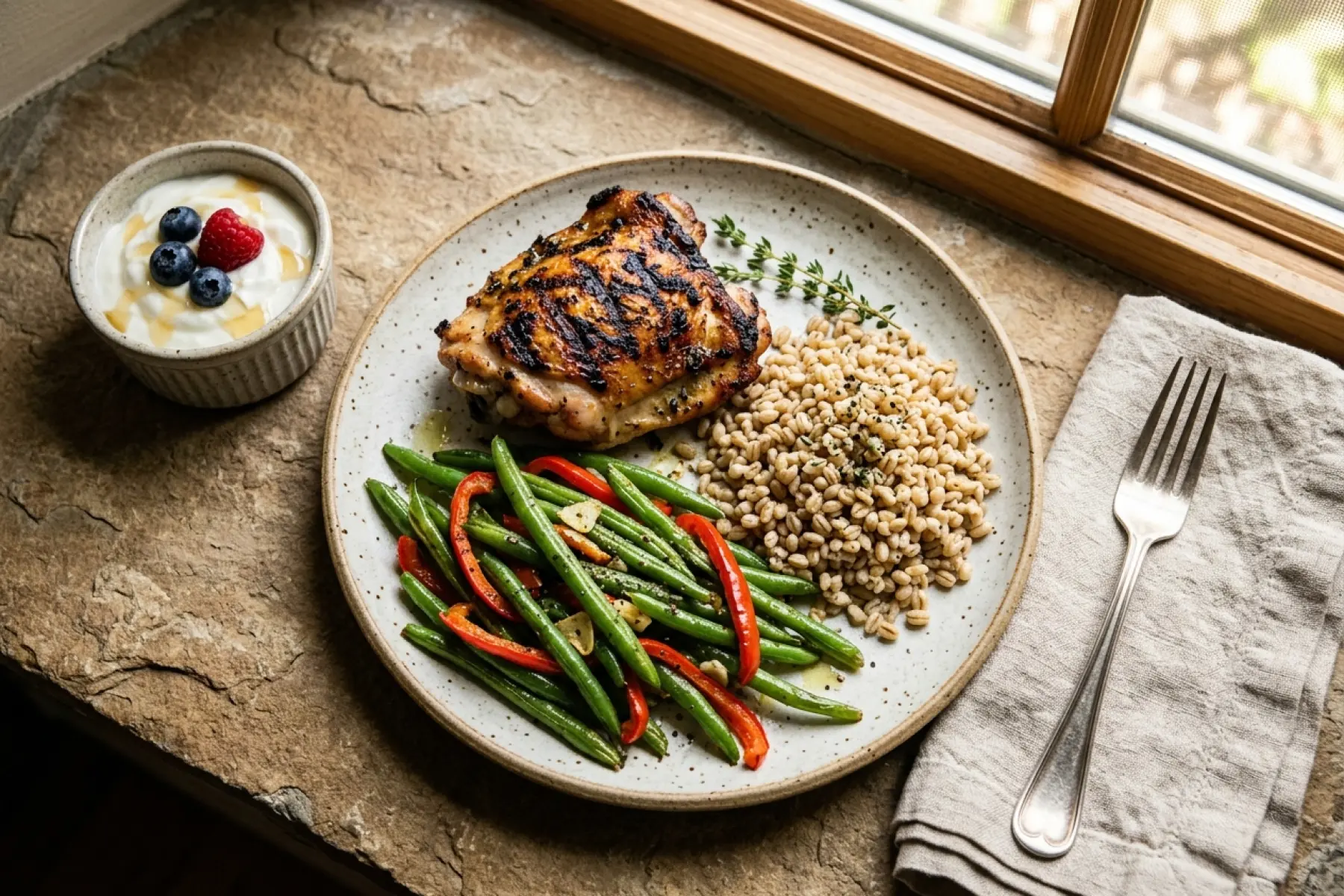
Chicken Thigh with Barley

150 g chicken thigh, 60 g cooked pearl barley, green beans and roast pepper.

610 kcal P 47g C 48g F 26g
Snack 2 min

Apple & Peanut Butter

One apple with 12 g natural peanut butter.

180 kcal P 4g C 22g F 8g

Note: Cook a full pot of barley tonight. It turns up again on Wednesday and Saturday.

2

Day 2

Tuesday
Legumes do the work
1,620 kcal 124g protein 124g net carbs 67g fat
Breakfast 8 min

Eggs with Avocado on Rye

2 eggs, quarter avocado, 1 slice dense rye, sliced tomato.

430 kcal P 23g C 30g F 24g
Lunch 6 min

Chickpea & Tuna Bowl

150 g chickpeas, 1 can tuna, spinach, lemon, 1 tsp olive oil.

470 kcal P 42g C 42g F 14g
Dinner 30 min

Salmon with Roast Vegetables

140 g salmon, roast zucchini, eggplant and onion, 140 g new potatoes.

610 kcal P 41g C 44g F 29g
Snack 1 min

Greek Yogurt

120 g 0% Greek yogurt with cinnamon.

110 kcal P 18g C 8g F 0g

Note: Leaving the skin on the potatoes adds fiber and slows things down, worth doing.

3

Day 3

Wednesday
Leftovers, reworked
1,615 kcal 95g protein 154g net carbs 67g fat
Breakfast 2 min

Overnight Oats with Chia

40 g oats, 10 g chia, 200 ml unsweetened soya milk, 80 g raspberries.

400 kcal P 18g C 48g F 15g
Lunch 5 min

Barley & Roast Veg Salad

Monday’s barley with leftover vegetables, 100 g chickpeas, herbs, vinaigrette.

470 kcal P 20g C 52g F 19g
Dinner 30 min

Turkey Chili

150 g ground turkey, kidney beans, peppers, tomato, 50 g cooked brown rice.

620 kcal P 52g C 50g F 22g
Snack

Handful of Almonds

20 g almonds.

125 kcal P 5g C 4g F 11g

Note: Chili freezes well. Make double and Thursday cooks itself.

4

Day 4

Thursday
Minimal effort
1,645 kcal 131g protein 140g net carbs 59g fat
Breakfast 3 min

Cottage Cheese & Pear

180 g cottage cheese, one sliced pear, 15 g pumpkin seeds.

395 kcal P 31g C 34g F 14g
Lunch 5 min

Turkey Chili, Round Two

Yesterday’s chili with a spoon of yogurt and a big side salad.

490 kcal P 45g C 42g F 15g
Dinner 20 min

Cod with White Beans & Greens

160 g cod, 150 g butter beans braised with garlic and spinach, olive oil.

585 kcal P 50g C 44g F 21g
Snack 2 min

Carrot Sticks & Hummus

Two carrots with 40 g hummus.

175 kcal P 5g C 20g F 9g

Note: Butter beans in place of potato or rice is one of the easiest fiber upgrades there is.

5

Day 5

Friday
Something to look forward to
1,705 kcal 126g protein 130g net carbs 74g fat
Breakfast 10 min

Mushroom & Spinach Omelette

3 eggs, mushrooms, spinach, 1 slice rye toast.

430 kcal P 31g C 26g F 22g
Lunch 10 min

Chicken & Quinoa Bowl

130 g chicken, 60 g cooked quinoa, roast broccoli, tahini dressing.

510 kcal P 45g C 44g F 18g
Dinner 25 min

Steak with Sweet Potato

150 g lean steak, 160 g sweet potato wedges, tenderstem broccoli.

620 kcal P 47g C 46g F 26g
Snack 1 min

Dark Chocolate & Strawberries

15 g 85% dark chocolate and 100 g strawberries.

145 kcal P 3g C 14g F 8g

Note: Sweet potato is not a free food, but at 160 g with protein alongside it behaves well.

6

Day 6

Saturday
Unhurried
1,615 kcal 107g protein 144g net carbs 64g fat
Breakfast 20 min

Shakshuka with Rye

2 eggs poached in tomato and pepper sauce, 1 slice rye, parsley.

415 kcal P 24g C 34g F 20g
Lunch 8 min

Barley, Feta & Herb Salad

70 g cooked barley, 30 g feta, cucumber, tomato, mint, olive oil.

465 kcal P 19g C 50g F 20g
Dinner 15 min

Shrimp & Vegetable Stir-Fry

180 g shrimp, mixed vegetables, 60 g cooked brown rice, ginger and soy.

555 kcal P 45g C 52g F 16g
Snack 1 min

Greek Yogurt & Walnuts

120 g Greek yogurt with 10 g walnuts.

180 kcal P 19g C 8g F 8g

Note: Stir-fries are where a small amount of rice disappears into a large amount of vegetables.

7

Day 7

Sunday
A proper roast
1,620 kcal 115g protein 164g net carbs 55g fat
Breakfast 6 min

Oatmeal with Seeds

45 g oats in 250 ml soya milk, 15 g mixed seeds, half a banana.

425 kcal P 19g C 52g F 16g
Lunch 6 min

Big Bean & Tuna Salad

150 g mixed beans, 1 can tuna, leaves, red onion, vinaigrette.

465 kcal P 43g C 40g F 15g
Dinner 60 min

Roast Chicken Dinner

160 g roast chicken, 160 g roast potatoes, carrots, cabbage, thin gravy.

640 kcal P 52g C 50g F 24g
Snack 1 min

Satsumas

Two satsumas.

90 kcal P 1g C 22g F 0g

Note: A roast is not off limits. Portion the potatoes deliberately and fill the rest of the plate with vegetables.

Week at a glance
1,641 kcal · 145.3g net carbs, averaged across 7 days
Build mine

The grocery list

One adult, seven days. Canned legumes are used throughout because they are cheap, high in fiber and require no planning. Dried are fine if you prefer.

0 of 61 ticked , ticks are saved in this browser.

Meat, fish & eggs

10

Fruit & vegetables

25

Dairy & chilled

5

Cupboard

21

If the plan does not fit you

No fixed plan survives contact with a real person’s allergies, budget and schedule. These are the swaps that keep the macros intact.

Vegetarian

Chicken, fish and turkey become tofu, tempeh, halloumi and extra legumes. Watch total carbohydrate when legumes replace meat. Beans bring carbs as well as protein.

Dairy-free

Greek yogurt becomes unsweetened soya yogurt (keeps the protein), feta becomes olives or toasted seeds.

Lower carbohydrate still

Halve the barley, rice and potato portions and double the non-starchy vegetables. Do not do this while on insulin or a sulfonylurea without talking to your prescriber first.

Gluten-free

Barley and rye both contain gluten. Use quinoa, brown rice and certified gluten-free bread instead.

Kidney disease

This plan is high in protein, potassium and phosphate from legumes and seeds. Speak to your renal dietitian before using it. It may need substantial changes.

Smaller appetite

Drop the afternoon snack and reduce the starch portions by a third. Keep protein and vegetables where they are.

What to eat, what to skip

Eat freely

  • Legumes, lentils, chickpeas, butter beans, kidney beans
  • Non-starchy vegetables in large quantities at lunch and dinner
  • Whole fruit, especially berries, apples, pears and citrus
  • Oats, barley, quinoa and brown rice in measured portions
  • Fish, including fatty fish twice a week
  • Eggs, Greek yogurt and cottage cheese
  • Nuts and seeds, a small handful, not a bowl
  • Olive oil, avocado and tahini as the main fats
  • Water, tea and coffee without sugar
  • Herbs, spices, vinegar, lemon and mustard

Leave these out

  • Fruit juice and smoothies, the fiber is gone and the sugar arrives fast
  • Sugary drinks, including “energy” and sports drinks
  • Large portions of white bread, white rice and refined cereal
  • Carbohydrate eaten on its own, with no protein or fat alongside
  • Very large evening meals after a low-carbohydrate day
  • Assuming “diabetic” or “no added sugar” products are automatically fine
  • Changing your diet significantly without telling whoever prescribes your medication

Read this before you change anything

If you take glucose-lowering medication, eating fewer carbohydrates than usual can push your blood glucose too low. This is the one genuinely dangerous thing about starting a plan like this unannounced, and it is easily avoided by telling your prescriber before you begin.

Insulin or sulfonylureas
Talk to your prescriber first
Doses are set against your usual intake, eating fewer carbs without adjusting them risks hypoglycaemia
Metformin alone
Lower hypo risk
Still worth mentioning at your next review, particularly if you are also losing weight
Carbs per main meal
~40–50 g here
Your own target may be higher or lower, a diabetes dietitian can set it properly
What to monitor
Readings, not weight
If you test, check before and two hours after meals during the first week and share the pattern

Six things that make this week easier

Eat the vegetables and protein first

Leaving the starch until last in a meal has been shown to lower the glucose rise that follows it. It costs nothing and requires no change to what is on the plate.

Walk after the biggest meal

Ten to fifteen minutes of easy walking after dinner blunts the post-meal rise measurably. It is probably the highest-return habit on this page.

Keep canned legumes in the cupboard

A can of chickpeas turns a thin salad into a meal with fiber and protein in about forty seconds. Stock more than you think you need.

Judge bread by fiber, not color

Plenty of brown bread is white flour with coloring. Look for 6 g of fiber per 100 g or more. Dense rye and seeded whole grain usually qualify.

Give it two weeks before judging

Day-to-day glucose readings bounce around for reasons that have nothing to do with breakfast. Patterns over a two weeks tell you something; a single spike does not.

Free generator

This plan is built for an average person. You are not one.

The menu above assumes about 1,641 calories a day and no allergies. Give us your height, weight, goal and the foods you refuse to eat, and the generator rebuilds this entire week around your actual numbers , recipes, macros and a fresh grocery list included.

No signup. No card. Takes about 30 seconds.

Questions people ask about this plan

Is this plan suitable for type 1 diabetes?

Not as written. Type 1 management is built around matching insulin to carbohydrate, and that requires carbohydrate counting set up with a specialist team. You are welcome to read this for meal ideas, but the portions and structure here are not a substitute for your own carb ratios.

How many carbs should I eat per day with type 2 diabetes?

There is no single answer, which is why this plan gives a pattern rather than a prescription. Roughly 130–160 g a day, spread evenly, suits many people; some do better lower, some need more. A diabetes dietitian can set a target for you, and the carb calculator is a reasonable starting point for the arithmetic.

Can I eat fruit if I have diabetes?

Yes. Whole fruit comes with fiber and water, and it behaves very differently from juice. Berries, apples, pears and citrus are used throughout this week. Fruit juice is the thing to drop. It delivers the sugar without the fiber that slows it down.

Will this plan reverse my diabetes?

It is not designed to make that claim, and no meal plan can promise it. Meaningful weight loss does put type 2 diabetes into remission for some people, particularly earlier after diagnosis, but that is a conversation for your clinical team, not something to infer from a week of recipes.

Do I need special “diabetic” foods?

No, and most are a waste of money. Products labelled for diabetics are often no lower in calories, sometimes high in fat, and occasionally contain sweeteners that upset digestion. Ordinary food in sensible proportions is the whole approach here.

What about sweeteners and diet drinks?

Non-sugar sweeteners do not raise blood glucose and are generally considered a reasonable swap for sugar. If you like diet drinks and they keep you off sugary ones, they are fine. There is no need to add them if you do not.

I take insulin. Can I follow this?

Possibly, but only after speaking to whoever manages your insulin. If this plan contains less carbohydrate than you usually eat, your current doses may now be too high, and that means hypoglycaemia. This is the single most important caution on the page.

Why is the fat content fairly high?

Because carbohydrate is moderate, and the energy has to come from somewhere. The fats used are mostly olive oil, fatty fish, nuts, seeds and avocado, the pattern associated with better cardiovascular outcomes, which matters a great deal in diabetes.

Can I lose weight on this plan?

At roughly 1,700 calories a day it will be a deficit for many adults, and weight loss tends to improve glucose control. If you want a defined deficit, check your maintenance with the calorie calculator first rather than guessing.

Can I get this adjusted to my own numbers?

Yes, the plan generator will build a week at your own calorie and carbohydrate targets, around foods you actually like. Bring the targets your clinician or dietitian gave you rather than inventing them.
Medical disclaimer. This plan is general nutrition information, not medical advice. Calorie and macro figures are estimates for the portions described and will vary with brands, cuts and cooking method. Talk to a doctor or registered dietitian before starting any new diet, especially if you are pregnant, breastfeeding, managing a medical condition, or taking medication that needs dosing around food.