1,500 Calories Free

7-Day 1500 Calorie Meal Plan

Seven days where every single one lands between 1,450 and 1,500 calories — portions weighed, macros counted, and 116 g of protein a day so the weight you lose is fat.

1,450-1,500
Daily calories
~1,476
Weekly average
~116 g
Protein/day
10-35 min
Cook time

What this plan actually does

Fifteen hundred calories is the most searched number in dieting, and it is the right number for a genuinely narrow group of people. It suits a shorter or lighter adult, someone mostly sedentary, or a woman of average height aiming for a steady half-kilo a week. For a 90 kg man who trains, it is far too low and will backfire within a fortnight.

That is worth saying plainly before the menu, because most 1,500-calorie plans do not say it. If the number is wrong for your body, no amount of good food choices will fix it — you will simply be hungry, tired, and eventually eating everything in the kitchen on a Thursday night.

If 1,500 genuinely is your number, this plan hits it precisely. Every day lands between 1,450 and 1,500, portions are given in grams because at this intake eyeballing is the difference between a deficit and a stall, and protein stays at 116 g so that what you lose is fat rather than muscle.

A good fit if

  • Adults under about 1.68 m aiming for steady, moderate fat loss
  • Mostly sedentary people whose maintenance sits near 1,800–1,900
  • Anyone in the last few kilos, where maintenance has genuinely fallen
  • People who prefer a fixed number to a flexible range
  • Anyone who wants weighed portions rather than judgement calls

Talk to a doctor first if

  • Most men — typical male maintenance makes 1,500 an aggressive 40% cut
  • Anyone training hard four or more times a week
  • Pregnancy or breastfeeding
  • Teenagers and children, at any activity level
  • Anyone with a history of disordered eating, where fixed targets are a known trigger

The rules behind the plan

Four principles decide every meal below. Understand these and you can improvise for the rest of your life instead of following someone else’s menu forever.

1

Check the number belongs to you first

Estimate maintenance, subtract 15–20%, and see whether the answer is near 1,500. If your maintenance is 2,400, this plan is a 38% deficit and it will not hold. The calorie calculator takes about a minute, and it is the most useful minute on this page.

2

Weigh the portions, at least at first

At 1,500 calories there is no slack. A heavy hand with oil is 150 calories, a generous cheese portion another 100, and that is 17% of the day gone before you noticed. Weigh for the first week and your eye becomes accurate enough afterwards.

3

Protein is held while fat is spent

Fat carries nine calories a gram, so cutting fat buys the most food for the fewest calories. Protein stays at 116 g regardless, because muscle loss at a low intake is the failure mode that makes the weight come back.

4

Four meals, so nothing feels like fasting

Roughly 350 / 400 / 480 / 250. Splitting 1,500 across four events keeps any single meal from feeling punitively small, and it puts protein into your body four separate times a day rather than one.

The full 7-day plan

Every meal, with calories and macros per portion. Daily totals are calculated from the meals themselves.

1

Day 1

Monday
1,500 exactly
1,500 kcal 116g protein 154g net carbs 43g fat
Breakfast 4 min

Greek Yogurt, Oats & Berries

150 g fat-free Greek yogurt with 30 g oats stirred in, 100 g berries and a teaspoon of honey.

350 kcal P 22g C 50g F 6g
Lunch 12 min

Chicken & Avocado Salad Wrap

130 g chicken breast in one small wholemeal wrap with a quarter avocado, leaves, tomato and a squeeze of lime.

420 kcal P 38g C 36g F 13g
Dinner 25 min

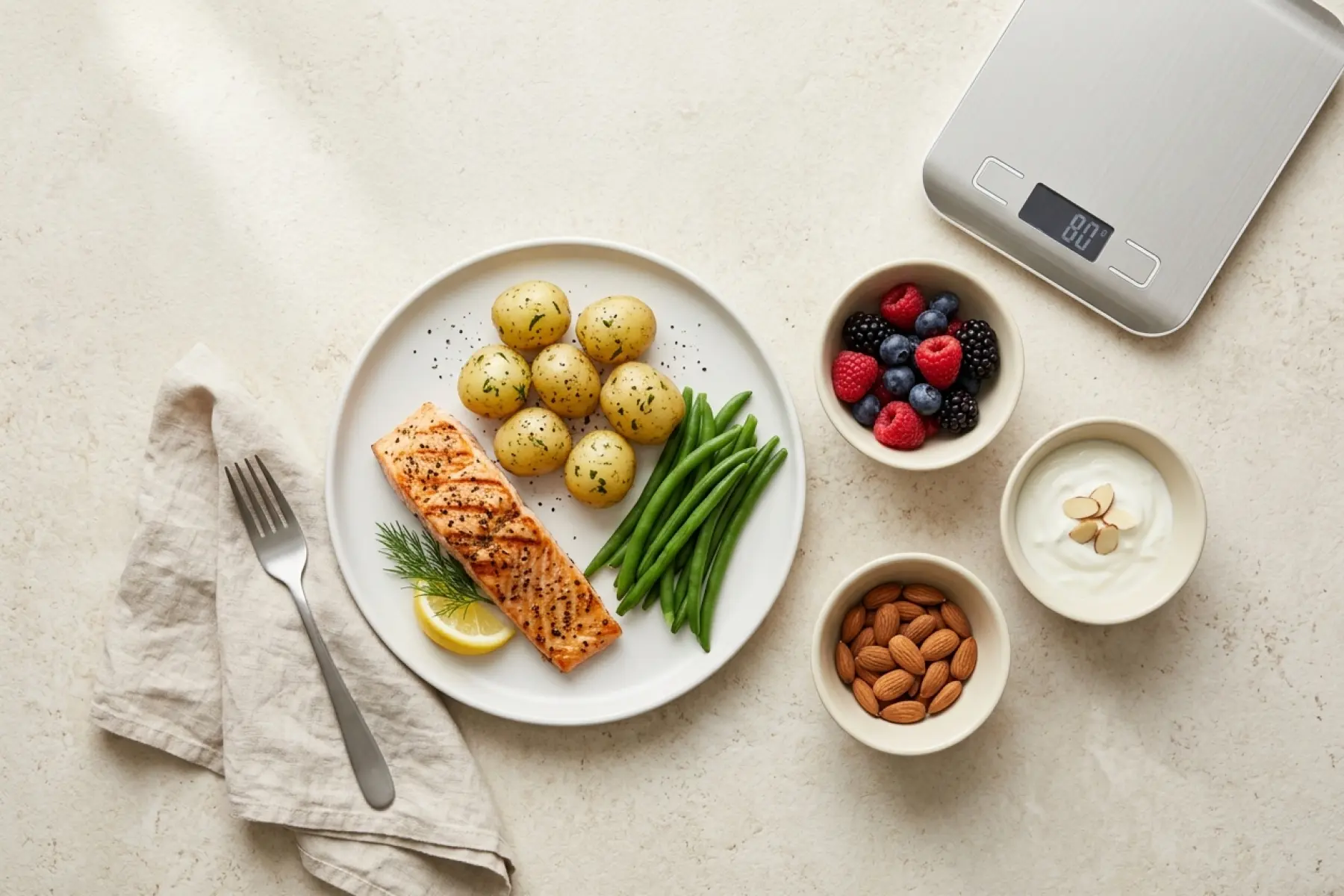
Salmon with New Potatoes & Green Beans

120 g salmon baked with lemon, 200 g new potatoes and a large pile of green beans.

490 kcal P 36g C 44g F 18g
Snack 2 min

Cottage Cheese & Apple

180 g cottage cheese with a sliced apple and cinnamon.

240 kcal P 20g C 24g F 6g

Note: Weigh the salmon and the potatoes. A 160 g fillet instead of 120 g adds 90 calories, which is most of this day’s margin gone in one swap.

2

Day 2

Tuesday
Store cupboard
1,460 kcal 121g protein 134g net carbs 42g fat
Breakfast 10 min

Two-Egg Scramble on Wholegrain Toast

Two eggs scrambled with grilled tomato, on two slices of wholegrain toast. No butter on the toast — the eggs carry it.

350 kcal P 22g C 34g F 13g
Lunch 8 min

Tuna & Chickpea Salad

One tin of tuna with 80 g chickpeas, cucumber, tomato, red onion and a teaspoon of olive oil with red wine vinegar.

390 kcal P 36g C 28g F 13g
Dinner 18 min

Chicken Stir Fry with Rice

130 g chicken with a whole bag of stir fry vegetables over 100 g cooked rice, with soy, garlic and ginger.

470 kcal P 40g C 50g F 10g
Snack 2 min

Greek Yogurt, Blueberries & Almonds

200 g fat-free Greek yogurt with 80 g blueberries and 10 g flaked almonds.

250 kcal P 23g C 22g F 6g

Note: Everything here except the chicken comes from a cupboard or a freezer. Useful for the day you meant to shop and did not.

3

Day 3

Wednesday
Cook once, eat twice
1,480 kcal 107g protein 169g net carbs 36g fat
Breakfast 4 min + overnight

Overnight Oats with Banana

35 g oats soaked overnight in 150 ml milk with half a sliced banana and 10 g mixed seeds.

340 kcal P 14g C 48g F 10g
Lunch 12 min in a microwave

Jacket Potato with Cottage Cheese

A 250 g potato baked until the skin crisps, with 150 g cottage cheese, chives and a large side salad.

400 kcal P 28g C 55g F 5g
Dinner 30 min

Turkey Meatballs with Pasta

120 g turkey mince rolled with garlic and oregano, baked and simmered in tomato sauce over 60 g dry pasta, with 10 g parmesan. Make double.

490 kcal P 42g C 52g F 11g
Snack 2 min

Skyr & Pistachios

200 g plain skyr with 12 g chopped pistachios.

250 kcal P 23g C 14g F 10g

Note: Double the meatballs tonight. Tomorrow’s lunch is built on them and it takes the day from 25 minutes of cooking to eight.

4

Day 4

Thursday
Lowest effort
1,490 kcal 124g protein 129g net carbs 50g fat
Breakfast 3 min

Protein Smoothie with Oats

One scoop of whey blended with 250 ml skimmed milk, 100 g frozen berries and 20 g oats.

350 kcal P 35g C 36g F 5g
Lunch 6 min

Leftover Turkey Meatball Salad

Last night’s meatballs cold or warm over a large salad, with a teaspoon of olive oil and balsamic.

400 kcal P 36g C 24g F 18g
Dinner 15 min

Prawn & Vegetable Noodles

150 g prawns with pak choi, peppers and spring onion through 55 g dry noodles, with soy and a little sesame oil.

450 kcal P 36g C 55g F 8g
Snack 8 min

Boiled Eggs, Carrots & Hummus

Two boiled eggs with carrot and pepper sticks and 30 g hummus.

290 kcal P 17g C 14g F 19g

Note: Lowest-carb day at 129 g and the highest fat at 50 g. Days do not have to match each other — only the weekly total matters.

5

Day 5

Friday
Lightest day
1,450 kcal 100g protein 166g net carbs 38g fat
Breakfast 5 min

Cottage Cheese on Rye with Tomato

150 g cottage cheese on two slices of rye with sliced tomato, black pepper and chives.

340 kcal P 26g C 40g F 6g
Lunch 30 min

Lentil Soup with Sourdough

A deep bowl of red lentil, carrot and cumin soup with one slice of sourdough.

380 kcal P 20g C 58g F 7g
Dinner 30 min

Pork Loin with Sweet Potato & Broccoli

130 g pork loin with 200 g sweet potato wedges and broccoli, roasted in a teaspoon of olive oil.

480 kcal P 38g C 46g F 14g
Snack 2 min

Greek Yogurt, Honey & Walnuts

150 g Greek yogurt with a teaspoon of honey and 10 g crushed walnuts.

250 kcal P 16g C 22g F 11g

Note: The lightest day at about 1,450. Make the soup in a double batch — it costs almost nothing and freezes in portions.

6

Day 6

Saturday
Weekend-proof
1,500 kcal 119g protein 121g net carbs 57g fat
Breakfast 12 min

Poached Eggs & Avocado on Sourdough

Two poached eggs with a quarter mashed avocado on one slice of sourdough, with chilli flakes and lemon.

360 kcal P 20g C 24g F 21g
Lunch 15 min

Chicken Caesar with Yogurt Dressing

130 g chicken over romaine with 15 g parmesan, 15 g croutons, and a dressing made from Greek yogurt, anchovy, lemon and garlic.

400 kcal P 42g C 18g F 17g
Dinner 35 min

Beef Chilli with Rice

120 g 5% beef mince with kidney beans, peppers and chipotle over 100 g cooked rice.

490 kcal P 38g C 55g F 11g
Snack 2 min

Skyr, Clementines & Dark Chocolate

150 g skyr with two clementines and 15 g of 85% dark chocolate.

250 kcal P 19g C 24g F 8g

Note: Chocolate is in the plan on Saturday deliberately. A 1,500-calorie week with no treat in it is a 1,500-calorie week you abandon on Sunday.

7

Day 7

Sunday
Prep day
1,450 kcal 122g protein 136g net carbs 40g fat
Breakfast 25 min

Shakshuka with Sourdough

Two eggs baked in spiced tomato and pepper with 20 g feta, and one slice of sourdough.

370 kcal P 22g C 30g F 18g
Lunch 15 min

Roast Chicken & Couscous Salad

130 g roast chicken with 100 g cooked couscous, roasted courgette and pepper, parsley and lemon.

410 kcal P 38g C 42g F 8g
Dinner 25 min

Cod with Crushed Potatoes & Peas

160 g cod roasted eight minutes, with 200 g potatoes crushed with a teaspoon of butter and lemon, and 80 g peas.

450 kcal P 38g C 48g F 9g
Snack 2 min

Cottage Cheese & Pineapple

200 g cottage cheese with 80 g fresh pineapple.

220 kcal P 24g C 16g F 5g

Note: While the chicken roasts, boil six eggs, make the lentil soup and soak Wednesday’s oats. Three of next week’s meals are then already done.

Week at a glance
1,476 kcal · 144.1g net carbs, averaged across 7 days
Build mine

The grocery list

One person, seven days. Quantities are tight on purpose — at 1,500 calories, buying a family pack and eating to the pack size is the commonest way the plan quietly stops working.

0 of 55 ticked — ticks are saved in this browser.

Meat, fish & eggs

10

Dairy & chilled

9

Produce

19

Pantry & freezer

17

If the plan does not fit you

No fixed plan survives contact with a real person’s allergies, budget and schedule. These are the swaps that keep the macros intact.

1,500 is too low for you

Add a second slice of toast at breakfast, 50 g more starch at lunch and dinner, and 20 g of nuts. That lands near 1,900, which is our balanced plan in a different order.

You want 1,200 calories

We would rather you did not. Below 1,200 it is genuinely hard to meet vitamin and mineral needs, muscle loss accelerates and adherence collapses. If a doctor has prescribed it, follow their plan, not this one.

Vegetarian

Eggs, cottage cheese, Greek yogurt, skyr, tofu, lentils and chickpeas cover it. Protein lands nearer 95 g, which is the practical floor at this calorie level.

You are still hungry

Add vegetables without counting them — another 200 g of broccoli or salad is about 50 calories. Then check you are drinking enough, and that you have not cut the protein anywhere.

No time to cook

Rotate the four fastest: jacket potato with cottage cheese, tuna and chickpea salad, the yogurt bowls, and a frozen stir fry bag with chicken. All under fifteen minutes.

You train three or more times a week

Raise to about 1,750 and put the extra calories on training days as carbs. Training hard at 1,500 leads to poor sessions, lost strength and a much higher chance of quitting.

What to eat, what to skip

Eat freely

  • Chicken breast, turkey, lean pork, 5% mince
  • White fish and prawns — the best protein per calorie available
  • Eggs, at two per serving
  • Fat-free Greek yogurt, skyr and cottage cheese
  • Potatoes, rice, pasta and oats — weighed, not eyeballed
  • Lentils, chickpeas and beans
  • Vegetables without limit, especially leafy and cruciferous
  • Whole fruit, two pieces a day
  • Wholegrain and rye bread, one or two slices
  • A measured 15 g of dark chocolate when you want it
  • Water, tea, coffee and zero-calorie drinks

Leave these out

  • Free-poured oil — one tablespoon is 8% of the day’s calories
  • Alcohol, which at this intake displaces food you actually need
  • Fruit juice, smoothies and lattes
  • Cheese by the block rather than by the gram
  • Nuts eaten by the handful — 30 g is a portion, 100 g is a meal
  • Shop-bought dressings, which can carry 150 calories per serving
  • Cereal bars and granola marketed as diet food
  • Family packs of anything you will eat to the pack size
  • Skipping meals, which at 1,500 leads directly to an evening binge
  • Going lower than this to speed it up

At 1,500 calories, nutrients get tight

The lower the intake, the less room there is for micronutrients. This plan is built to cover them, but these four are the ones that slip first on any low-calorie diet — watch them, especially past a month.

Protein
116 g/day
Never cut this to make room for something else
Fibre
25-30 g/day
Beans, oats, skins on potatoes, whole fruit
Iron
Watch if vegetarian
Red meat, lentils and spinach with vitamin C
Calcium
700 mg/day
The dairy in this plan covers it; swaps must replace it

Six things that make this week easier

Buy a kitchen scale before you start

At this intake, the gap between an estimated and a weighed portion is routinely 300 calories a day. That is the entire deficit. A scale costs less than a week of the shopping list.

Measure oil with a spoon, never the bottle

One tablespoon is about 120 calories. Two seconds of free pouring is commonly three tablespoons, which is 360 — nearly a quarter of the day.

Vegetables are free, use them

Another 200 g of broccoli, cabbage or salad adds roughly 50 calories and a large amount of volume. When a meal leaves you hungry, this is the first lever.

Drink before you snack

At a low intake, thirst is misread as hunger constantly. A glass of water and ten minutes settles most unplanned snacking.

Average your weight over seven days

A single morning reading swings by up to 2 kg. Compare this week’s average with last week’s, or you will conclude a working plan has failed.

Take a maintenance break every 8-12 weeks

A week or two at maintenance restores training quality, hunger signalling and mood. It barely slows the result and it markedly improves the odds you finish.

Free generator

This plan is built for an average person. You are not one.

The menu above assumes about 1,476 calories a day and no allergies. Give us your height, weight, goal and the foods you refuse to eat, and the generator rebuilds this entire week around your actual numbers — recipes, macros and a fresh grocery list included.

No signup. No card. Takes about 30 seconds.

Questions people ask about this plan

Is 1,500 calories a day enough?

For some people, yes; for many, no. It is a reasonable deficit for a shorter or lighter adult whose maintenance sits near 1,800–1,900. For an average man, whose maintenance is often 2,400–2,600, it is a 40% cut and will produce hunger, fatigue, muscle loss and a binge. Work out your own maintenance first with the calorie calculator and only use 1,500 if it lands 15–20% below it.

How much weight will I lose on 1,500 calories a day?

It depends entirely on your maintenance, not on the 1,500. If yours is 1,900, you are 400 down a day, which is roughly 0.4 kg a week. If it is 2,400, you are 900 down and losing closer to 0.9 kg — faster, but with much more muscle loss and much lower odds of sticking with it. The first week always shows more because of water.

Can a man eat 1,500 calories a day?

Only in specific circumstances — a shorter, sedentary or older man, or someone in the final few kilos, and ideally with supervision. For most men it is too aggressive. A better target is 1,900–2,200, which still produces steady loss while keeping training and mood intact.

Do I really need to weigh my food?

For the first week or two, yes. At 1,500 calories the margin for error is tiny, and the foods people misjudge most — oil, cheese, nuts, cereal, rice — are all calorie dense. Once your eye is calibrated you can stop, and re-weigh for a few days if progress ever stalls.

Why is protein so high on a low calorie plan?

Because low intake is exactly when muscle is most at risk, and protein is what protects it. It is also the most filling macro per calorie, which matters more at 1,500 than at 2,500. Protein is the last thing to cut on this plan, not the first.

Can I eat the same thing every day instead?

Yes, and many people find repetition easier because it removes decisions. Pick two breakfasts, two lunches and three dinners from this plan and rotate them. The only cost is variety of micronutrients, which you can cover by keeping the vegetables varied.

What if I am starving by the evening?

Move calories later. Make breakfast smaller and dinner bigger, or shift the snack to after dinner. Total daily calories are what drive fat loss, and there is no metabolic penalty for eating later — only a behavioural one if late eating leads to more of it.

Is 1,200 calories better for faster results?

No. Below about 1,200 it becomes genuinely difficult to hit basic vitamin and mineral needs, lean mass loss accelerates, and dropout rates climb steeply. Faster on paper, slower in practice, because the plans people abandon produce no results at all.

How long can I stay at 1,500 calories?

Eight to twelve weeks, then a week or two at maintenance before continuing if you still have weight to lose. Long uninterrupted low-calorie stretches wear down adherence and training quality. Planned breaks make the whole thing more sustainable without meaningfully slowing the result.

What if I want this at a different calorie target?

Use the swaps above to move up or down, or let the meal plan generator build the whole week at your exact number. It takes your height, weight, activity and food dislikes and produces the menu, macros and grocery list in about thirty seconds.
Medical disclaimer. This plan is general nutrition information, not medical advice. Calorie and macro figures are estimates for the portions described and will vary with brands, cuts and cooking method. Talk to a doctor or registered dietitian before starting any new diet, especially if you are pregnant, breastfeeding, managing a medical condition, or taking medication that needs dosing around food.