Blood Pressure Free

7-Day DASH Diet Meal Plan

Low sodium, high potassium, plenty of vegetables and low-fat dairy, the DASH pattern as an ordinary, well-seasoned week of food.

~1,750
Daily calories
<1,800 mg
Sodium/day
~36 g
Fiber/day
8–9 servings
Veg & fruit

What this plan actually does

DASH stands for Dietary Approaches to Stop Hypertension. Unlike most named diets it came out of controlled feeding trials, and it produced measurable blood pressure reductions within weeks. Larger still when sodium was also restricted. That evidence base is why it is routinely recommended by cardiology and public health bodies.

The pattern is specific: eight to nine servings of vegetables and fruit a day, two to three of low-fat dairy, plenty of whole grains, nuts and legumes several times a week, limited red and processed meat, and sodium kept low. This week hits those targets while still tasting of something, the seasoning simply comes from herbs, citrus, garlic, vinegar and spice instead of salt.

The trade-off is honest: you will cook more and eat less packaged food, because roughly three quarters of the sodium in a typical diet arrives already inside products rather than from the salt cellar. If you take blood pressure medication, read the watchouts before starting. Blood pressure can fall enough to need a dose review.

A good fit if

  • Anyone with raised blood pressure looking for a dietary approach with real evidence behind it
  • People told to reduce salt who do not know where to start
  • Anyone wanting a pattern recommended by cardiology guidelines rather than an influencer
  • Households happy to cook most meals from scratch
  • People who also want to reduce cardiovascular risk more broadly

Talk to a doctor first if

  • Anyone with advanced kidney disease, this is deliberately high in potassium
  • People on potassium-sparing diuretics or ACE inhibitors without clinician sign-off
  • Anyone who has been told to restrict fluid or potassium for a medical reason
  • Those who cannot cook most meals, sodium targets are very hard to hit on packaged food
  • Anyone stopping or reducing medication on the strength of a diet

The rules behind the plan

Four principles decide every meal below. Understand these and you can improvise for the rest of your life instead of following someone else’s menu forever.

1

Sodium down, hard

Under about 1,800 mg a day. Most of the reduction comes from not buying packaged food, not from refusing the salt cellar. Bread, sauces, cured meat and ready meals carry the bulk of it.

2

Potassium up

Potatoes, bananas, beans, leafy greens, tomatoes and yogurt throughout. Potassium helps the body excrete sodium, and the sodium-to-potassium ratio predicts blood pressure better than sodium alone.

3

Low-fat dairy every day

Two to three servings. This is one of the details that distinguishes DASH from a generic healthy diet, and it was part of the trial design rather than an afterthought.

4

Flavor without salt

Lemon, vinegar, garlic, black pepper, smoked paprika, herbs and chili. Salt is a habit as much as a taste, and most palates recalibrate within a two weeks.

The full 7-day plan

Every meal, with calories and macros per portion. Daily totals are calculated from the meals themselves.

1

Day 1

Monday
Recalibrate the palate
1,755 kcal 103g protein 214g net carbs 52g fat
Breakfast 6 min

Oatmeal with Banana & Walnuts

50 g oats in 250 ml 2% milk, one banana, 20 g walnuts.

490 kcal P 20g C 66g F 17g
Lunch 8 min

Bean & Vegetable Salad

150 g no-salt-added mixed beans, tomato, cucumber, pepper, olive oil, lemon.

465 kcal P 21g C 56g F 17g
Dinner 30 min

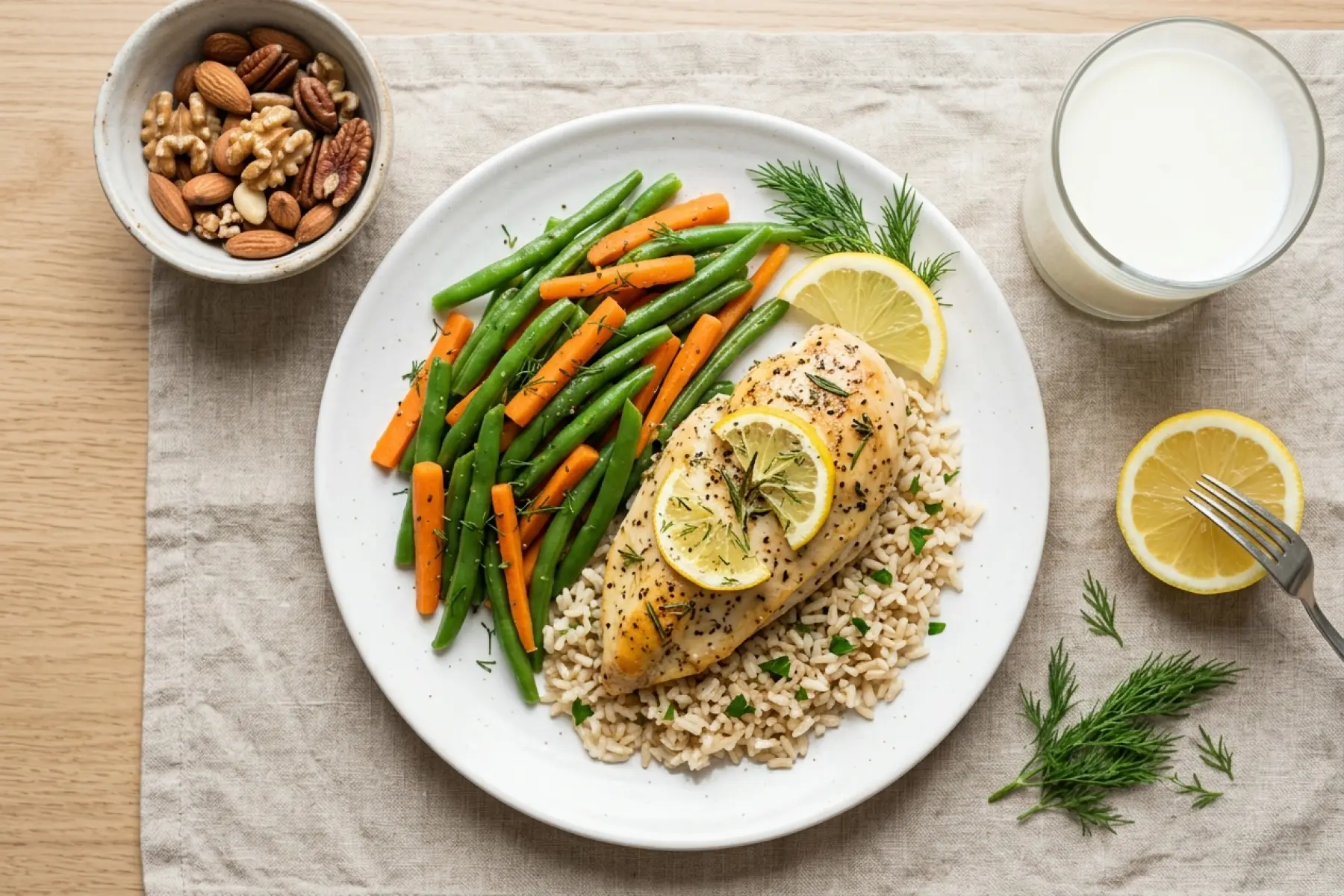
Herb Chicken with Brown Rice

150 g chicken breast with lemon and thyme, 70 g brown rice, green beans, carrots.

620 kcal P 50g C 66g F 15g
Snack 1 min

Yogurt & Berries

150 g low-fat natural yogurt with 100 g blueberries.

180 kcal P 12g C 26g F 3g

Note: Buy no-salt-added canned beans if you can find them, and rinse whichever you buy. It removes a surprising amount of sodium.

2

Day 2

Tuesday
Potassium-forward
1,710 kcal 99g protein 215g net carbs 48g fat
Breakfast 3 min

Yogurt, Oats & Fruit

200 g low-fat yogurt, 40 g oats, one sliced pear, 15 g almonds.

465 kcal P 24g C 62g F 13g
Lunch 12 min

Baked Potato with Tuna

250 g baked potato, 1 can no-salt tuna, corn, yogurt and chive dressing, side salad.

520 kcal P 42g C 66g F 8g
Dinner 35 min

Lentil & Vegetable Stew

150 g green lentils, carrot, celery, tomato, garlic, herbs, 1 slice low-salt bread.

560 kcal P 28g C 82g F 12g
Snack

Unsalted Nuts

25 g unsalted mixed nuts.

165 kcal P 5g C 5g F 15g

Note: A baked potato with the skin on is one of the highest-potassium foods in an ordinary shop.

3

Day 3

Wednesday
Fish and greens
1,715 kcal 88g protein 223g net carbs 51g fat
Breakfast 2 min

Overnight Oats with Berries

50 g oats, 200 ml 2% milk, 120 g raspberries, 10 g flaxseed.

450 kcal P 20g C 64g F 13g
Lunch 5 min

Lentil Stew, Round Two

Yesterday’s stew with a big leafy salad and lemon dressing.

510 kcal P 26g C 74g F 11g
Dinner 30 min

Baked Salmon with Sweet Potato

140 g salmon, 200 g sweet potato, broccoli, dill and lemon.

650 kcal P 41g C 58g F 27g
Snack 1 min

Banana

One banana.

105 kcal P 1g C 27g F 0g

Note: Dill, lemon and black pepper make salmon taste seasoned without a grain of salt.

4

Day 4

Thursday
Simple and green
1,775 kcal 109g protein 218g net carbs 51g fat
Breakfast 8 min

Scrambled Eggs on Low-Salt Toast

2 eggs, 2 slices low-salt whole wheat bread, grilled tomato, black pepper.

445 kcal P 25g C 46g F 18g
Lunch 10 min

Chickpea & Spinach Bowl

150 g chickpeas, spinach, roast pepper, 60 g brown rice, tahini and lemon.

545 kcal P 22g C 74g F 18g
Dinner 20 min

Turkey & Vegetable Stir-Fry

150 g turkey breast, mixed vegetables, garlic and ginger, 70 g brown rice, no added salt.

610 kcal P 50g C 68g F 13g
Snack 1 min

Yogurt & Apple

150 g low-fat yogurt with a chopped apple.

175 kcal P 12g C 30g F 2g

Note: Standard soy sauce would blow the day’s sodium budget in one spoonful. Use garlic, ginger and rice vinegar instead.

5

Day 5

Friday
A bit more generous
1,755 kcal 102g protein 192g net carbs 63g fat
Breakfast 3 min

Banana & Almond Smoothie

One banana, 250 ml 2% milk, 150 g yogurt, 20 g almond butter.

480 kcal P 26g C 52g F 19g
Lunch 12 min

Big Rainbow Salad with Egg

2 boiled eggs, leaves, beets, carrot, cucumber, 60 g barley, olive oil and vinegar.

495 kcal P 24g C 52g F 20g
Dinner 25 min

Cod with Potatoes & Peas

170 g cod baked with lemon and parsley, 220 g new potatoes, peas.

585 kcal P 47g C 66g F 12g
Snack 1 min

Unsalted Nuts & Orange

20 g unsalted nuts and one orange.

195 kcal P 5g C 22g F 12g

Note: Peas are cheap, high in potassium and take three minutes. They belong on this plan more often than they get used.

6

Day 6

Saturday
Cooking properly
1,755 kcal 106g protein 204g net carbs 56g fat
Breakfast 12 min

Mushroom & Tomato Omelette

3 eggs, mushrooms, tomato, herbs, 1 slice low-salt bread.

445 kcal P 29g C 32g F 22g
Lunch 10 min

Barley & Roast Vegetable Salad

80 g cooked barley, roast zucchini, pepper and onion, herbs, olive oil, lemon.

490 kcal P 15g C 74g F 16g
Dinner 40 min

Chicken & Vegetable Tagine

150 g chicken, chickpeas, apricot, cumin and cinnamon, 70 g couscous.

660 kcal P 50g C 76g F 15g
Snack 1 min

Yogurt & Berries

150 g low-fat yogurt with 100 g strawberries.

160 kcal P 12g C 22g F 3g

Note: Warm spices do a lot of the work salt usually does. Cumin, cinnamon and paprika especially.

7

Day 7

Sunday
Roast without the salt
1,755 kcal 100g protein 234g net carbs 47g fat
Breakfast 7 min

Oatmeal with Apple & Cinnamon

50 g oats in 250 ml 2% milk, grated apple, cinnamon, 15 g walnuts.

465 kcal P 19g C 66g F 15g
Lunch 25 min

Bean & Tomato Soup

Home-made butter bean and tomato soup, no bouillon cube, 1 slice low-salt bread.

445 kcal P 20g C 66g F 11g
Dinner 60 min

Roast Chicken & Vegetables

160 g roast chicken with herbs, 200 g roast potatoes, carrots, cabbage, no-salt gravy.

680 kcal P 52g C 70g F 19g
Snack 1 min

Pear & Yogurt

One pear with 100 g low-fat yogurt.

165 kcal P 9g C 32g F 2g

Note: Bouillon cubes are the single biggest hidden sodium source in home cooking. Use herbs, garlic and roasted vegetable juices instead.

Week at a glance
1,746 kcal · 214.3g net carbs, averaged across 7 days
Build mine

The grocery list

One adult, seven days. Look for “no salt added” cans and low-salt bread. Those two swaps alone remove several hundred milligrams a day.

0 of 57 ticked , ticks are saved in this browser.

Meat, fish & eggs

7

Fruit & vegetables

27

Dairy & chilled

2

Cupboard

21

If the plan does not fit you

No fixed plan survives contact with a real person’s allergies, budget and schedule. These are the swaps that keep the macros intact.

Vegetarian

Chicken, turkey and fish become tofu, eggs, extra legumes and low-fat dairy. DASH is already close to vegetarian. This is one of the easier swaps on the site.

Dairy-free

Use fortified unsweetened soya milk and soya yogurt, which keep both the protein and the calcium. This matters. Dairy servings are part of the DASH pattern, not incidental.

Gluten-free

Barley, couscous and wheat bread all go. Use brown rice, quinoa, buckwheat and certified gluten-free low-salt bread.

Kidney disease

Do not use this plan without renal dietitian input. It is deliberately high in potassium and phosphate, which may be exactly wrong for you.

Want weight loss too

Reduce the starch portions at lunch and dinner by about a third and drop one snack. Keep the vegetable, fruit and dairy servings intact. Those are the mechanism.

Eating out this week

Restaurant food is very high in sodium. Keep your home days tight, choose grilled over sauced, and ask for dressings on the side.

What to eat, what to skip

Eat freely

  • Vegetables at every meal, aim for four to five servings a day
  • Fruit, four to five servings a day, mostly whole
  • Low-fat dairy: milk, natural yogurt, two to three servings
  • Whole grains: oats, brown rice, barley, low-salt whole wheat bread
  • Legumes, nuts and seeds, unsalted, most days
  • Skinless poultry and fish rather than red meat
  • Potassium-rich foods: potatoes with skin, bananas, beans, spinach, tomatoes
  • Herbs, garlic, citrus, vinegar and spice as the main seasoning
  • Water as the default drink
  • Unsalted nuts for snacking

Leave these out

  • Salt added at the table and, mostly, in the pan
  • Bouillon cubes, gravy granules, soy sauce and bottled sauces
  • Cured and processed meat, bacon, ham, salami, sausages
  • Ready meals, canned soup and most packaged bread
  • Salted nuts, chips and savory snacks
  • Hard cheese in large amounts, it is very high in sodium
  • Excess alcohol, which raises blood pressure directly

Before you start, if you take medication

DASH works. That is the reason for caution: if you are already on blood pressure medication, the diet can lower your blood pressure enough to cause dizziness or falls unless the dose is reviewed. The potassium content matters too, for anyone with kidney disease or on certain drugs.

On BP medication
Tell your prescriber
Expect a possible dose review, readings can drop within two weeks
ACE inhibitors / ARBs
Potassium caution
These raise potassium; a high-potassium diet on top needs clinical sign-off
Chronic kidney disease
Not suitable as written
Potassium and phosphate here may be well above your limits, ask a renal dietitian
Expected effect
~5–11 mmHg systolic
Larger when sodium is also low; takes about two weeks to show

Six things that make this week easier

Read labels for salt, not just calories

Anything over 1.5 g salt (0.6 g sodium) per 100 g is high. Bread, sauces and breakfast cereal are where the surprises usually are.

Acid replaces salt better than anything else

A squeeze of lemon or a splash of vinegar at the end of cooking makes a dish taste seasoned. It is the single most useful trick on a low-sodium diet.

Give your palate two weeks

Salt preference genuinely recalibrates. Food that tastes flat on day three usually tastes normal by day fourteen, and old favourites start tasting oversalted.

Rinse canned legumes

Draining and rinsing canned beans removes a meaningful share of their sodium. If no-salt-added cans are available, better still.

Measure at home, same time daily

Single readings are noisy. A home monitor used at the same time each morning over two weeks will show you whether this is working far better than an occasional clinic check.

Free generator

This plan is built for an average person. You are not one.

The menu above assumes about 1,746 calories a day and no allergies. Give us your height, weight, goal and the foods you refuse to eat, and the generator rebuilds this entire week around your actual numbers , recipes, macros and a fresh grocery list included.

No signup. No card. Takes about 30 seconds.

Questions people ask about this plan

What is the DASH diet?

Dietary Approaches to Stop Hypertension, an eating pattern developed and tested in controlled trials specifically to lower blood pressure. It emphasises vegetables, fruit, low-fat dairy, whole grains, legumes and nuts, while limiting sodium, red meat, and sugary food and drink.

How much does DASH lower blood pressure?

In the original trials, roughly 5–6 mmHg systolic on its own, and up to about 11 mmHg in people with hypertension when sodium was also reduced. That is a clinically meaningful effect, comparable to some medication, which is exactly why you should not adjust medication yourself.

How much salt is allowed on DASH?

The standard version targets around 2,300 mg sodium a day and the lower-sodium version around 1,500 mg. This plan sits under roughly 1,800 mg, between the two. For context, that is about three quarters of a teaspoon of salt in total, including everything already inside food.

Can I still eat bread and cheese?

Bread yes, if you choose a low-salt loaf. Ordinary bread is one of the largest sodium contributors in most diets purely because people eat a lot of it. Hard cheese is genuinely difficult on this plan; small amounts occasionally rather than daily.

Is DASH good for weight loss?

It was not designed for it, and this version at roughly 1,750 calories is around maintenance for many adults. It does tend to produce modest weight loss because it displaces processed food. If weight loss is a goal, set the calorie level deliberately using the calorie calculator.

Can I use a low-sodium salt substitute?

They work for many people, but most replace sodium with potassium chloride, which makes them a genuinely bad idea if you have kidney disease or take an ACE inhibitor, ARB or potassium-sparing diuretic. Check with your pharmacist first.

How is DASH different from the Mediterranean diet?

They overlap heavily. DASH is more prescriptive about daily servings, includes low-fat dairy explicitly, and targets sodium directly. The Mediterranean pattern uses more olive oil and fish and is less concerned with salt. Both have strong evidence; our Mediterranean plan is the alternative.

Why is low-fat dairy specified rather than full-fat?

Because that is what the trials used, and the trials are the reason DASH is recommended. There is reasonable debate about dairy fat generally, but if you want the pattern that was actually tested, low-fat is what it contained.

How long before I see a change?

Blood pressure responds faster than most people expect, often within two weeks. Use a home monitor at the same time each morning and look at the trend across a two weeks rather than reacting to single readings.

Can I get this built to my own targets?

Yes, the plan generator will build a week around your calorie needs and food preferences. If your clinician gave you a specific sodium target, use theirs rather than the one on this page.
Medical disclaimer. This plan is general nutrition information, not medical advice. Calorie and macro figures are estimates for the portions described and will vary with brands, cuts and cooking method. Talk to a doctor or registered dietitian before starting any new diet, especially if you are pregnant, breastfeeding, managing a medical condition, or taking medication that needs dosing around food.