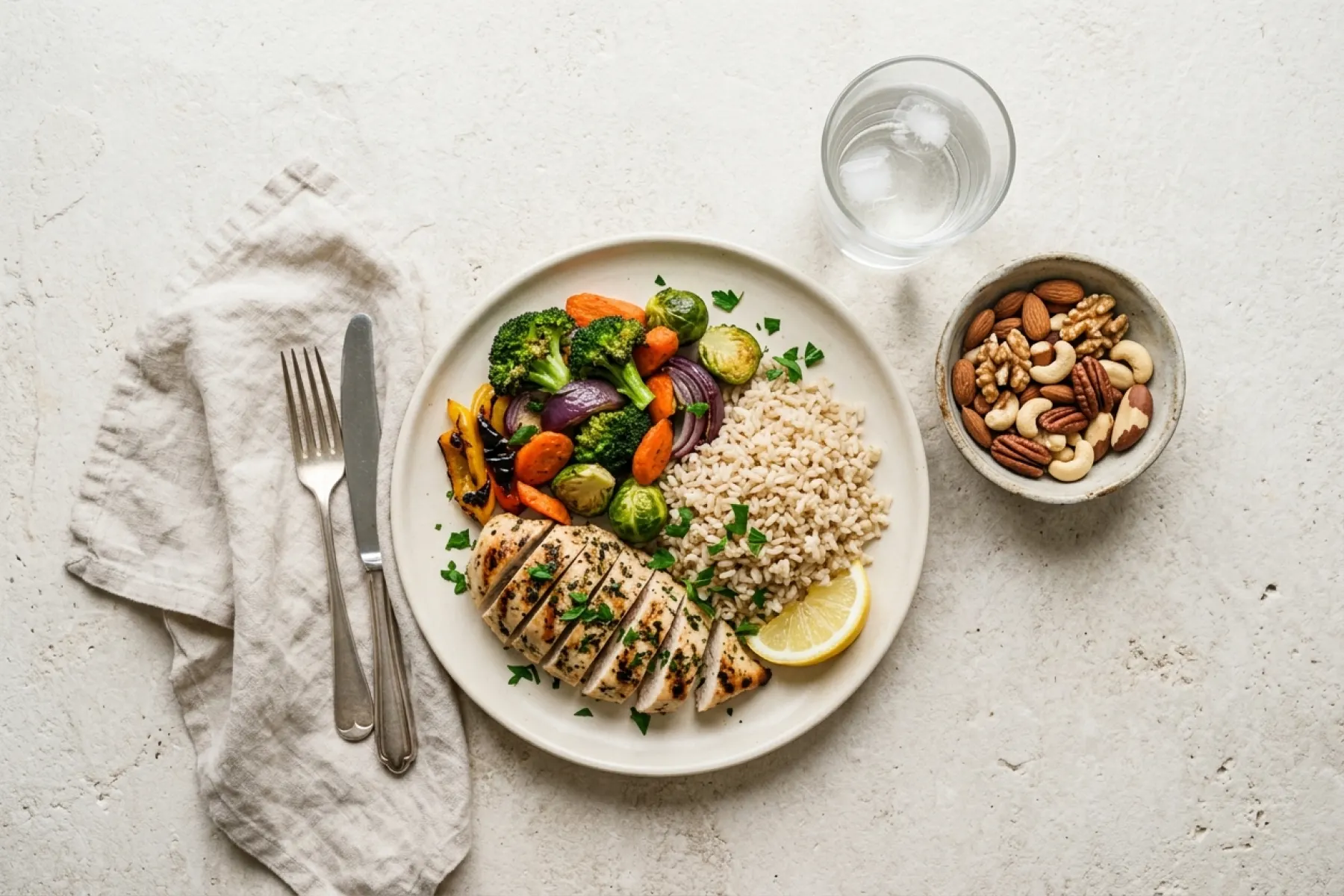
Why 2,000 calories specifically?
It is the reference amount regulators chose for nutrition labels because it sits near the middle of a wide range of real adult calorie needs, which makes the printed percentages roughly meaningful across most people, even though no single person is exactly average.
Is 2,000 calories right for me?
Possibly, but individual maintenance realistically ranges from about 1,600 to 3,000 calories depending on size, sex, muscle mass and activity level. Use the calorie calculator to get a number built on your own numbers rather than a label default.
Will I lose weight eating 2,000 calories a day?
Only if 2,000 sits below your personal maintenance. For a smaller or less active adult it often is a mild deficit; for a larger or more active one it is closer to maintenance. Track your weight trend over two to three weeks to find out which applies to you.
Is this plan the same for men and women?
The plan itself is identical, but maintenance calories typically run higher for men due to greater average muscle mass, so 2,000 calories is more often a deficit for women and closer to maintenance for men. The structure and food choices work equally well either way — only the total needs adjusting.
Can I follow this as a vegetarian?
Yes. Two meals are already meat-free, and the rest swap cleanly for tofu, halloumi, extra beans or chickpeas in place of the chicken, beef, turkey and salmon.
Why does the plan include chocolate and pizza?
Because banning entire foods is what usually breaks a plan by week two. Both appear here in a measured portion that fits inside 2,000 calories — the plan is built to be followed for months, not survived for a week.
How accurate are the calorie numbers on food labels?
Reasonably close but not exact — labelling regulations typically allow a margin of error, and home cooking introduces its own variation in portion size. Treat every number here, and on every label, as a good estimate rather than a lab-grade measurement.
Do I need to hit 2,010 calories exactly every day?
No. Being within roughly 100–150 calories on any given day makes no measurable difference. What matters is the weekly average staying close to your actual target.
What if I want a plan built around my own exact number instead?
That is exactly what the meal plan generator does — enter your stats and goal and it builds a 7-day plan around your real number instead of the label default, in about thirty seconds.
What do I do after the seven days are up?
Repeat it, rotating a few proteins and vegetables so it does not get repetitive. If your weight trend over two weeks tells you 2,000 is not the right number, adjust portions up or down and keep the same structure.