1,200 Calories Free

7-Day 1,200 Calorie Meal Plan

A low, deliberate intake built around protein and volume. With a clear-eyed look at whether you should be eating this little at all.

~1,200
Daily calories
~93 g
Protein/day
~28 g
Fiber/day
20–25 min
Cook time

What this plan actually does

1,200 calories is the number the internet reaches for by default, and it is far lower than most people assume. For a large share of adults, particularly men, anyone tall, anyone training hard, it sits below what the body burns at complete rest. That is not automatically dangerous, but it is not a neutral starting point either, and it should be a decision rather than a default.

This plan is built for the people it genuinely fits: smaller or shorter adults, those who are largely sedentary, and people working with a dietitian or clinician on a short, supervised deficit. It leans on protein and high-volume vegetables so the days feel like meals rather than rations, and it keeps fiber near 28 g so digestion and fullness hold up.

If you finish the week hungry, cold, foggy or sleeping badly, that is information, not failure. The honest answer for most people is to eat more, the 1,500 calorie plan or the calorie-deficit plan will almost always out-perform this one over months, because they are possible to keep doing.

A good fit if

  • Shorter or smaller-framed adults whose maintenance genuinely sits near 1,600–1,800 kcal
  • Largely sedentary weeks, desk work, little structured training
  • A short, defined push rather than an open-ended way of eating
  • Anyone doing this with a dietitian or doctor already involved
  • People who would rather eat three real meals than graze all day

Talk to a doctor first if

  • Most adult men, this typically lands below resting metabolic rate
  • Anyone pregnant, breastfeeding, or under 18
  • Anyone training hard, lifting heavily, or on their feet all day
  • Anyone with a history of disordered eating, please speak to a professional first
  • Anyone who has already been eating very little for weeks or months

The rules behind the plan

Four principles decide every meal below. Understand these and you can improvise for the rest of your life instead of following someone else’s menu forever.

1

Protein first, every meal

Each meal is anchored by 25–35 g of protein. At 1,200 calories the body will take some energy from lean tissue unless you give it a steady reason not to, and protein is that reason.

2

Volume over density

Vegetables are measured in handfuls, not teaspoons. A plate that fills you visually and physically is the difference between a plan you finish and one you abandon by Wednesday.

3

Fat is small but deliberate

Around 38 g a day. Enough for hormone function and for fat-soluble vitamins to actually be absorbed. Dropping it further to buy more food is a false economy.

4

Nothing is eliminated

Carbs, bread, fruit and dairy all stay. Removing whole food groups on top of a low intake adds difficulty without adding results.

The full 7-day plan

Every meal, with calories and macros per portion. Daily totals are calculated from the meals themselves.

1

Day 1

Monday
Start simple
1,200 kcal 108g protein 107g net carbs 35g fat
Breakfast 3 min

Greek Yogurt with Berries

200 g 0% Greek yogurt, 100 g mixed berries, 15 g flaked almonds.

300 kcal P 26g C 24g F 11g
Lunch 10 min

Chicken & Big Salad

130 g cooked chicken breast over a large mixed salad, 1 tsp olive oil and lemon.

385 kcal P 44g C 14g F 15g
Dinner 25 min

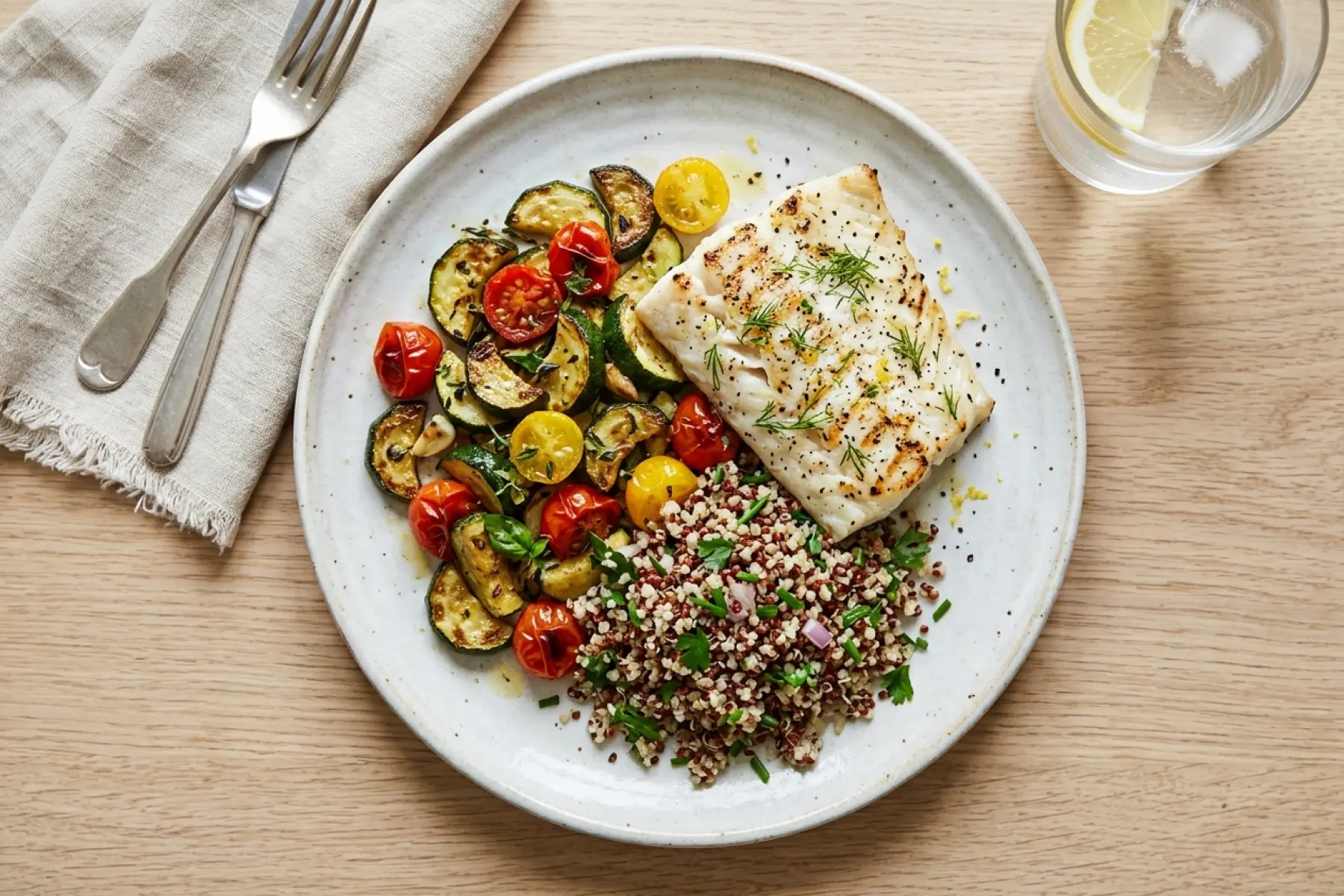
Baked Cod with Roast Veg

150 g cod, a tray of zucchini, pepper and red onion, 120 g new potatoes.

420 kcal P 37g C 44g F 9g
Snack 1 min

Apple & Cinnamon

One medium apple, sliced, with cinnamon.

95 kcal P 1g C 25g F 0g

Note: Roast a double tray of vegetables tonight. Tuesday lunch uses the rest.

2

Day 2

Tuesday
Leftovers earn their keep
1,205 kcal 83g protein 125g net carbs 41g fat
Breakfast 7 min

Two-Egg Scramble on Rye

2 eggs scrambled, 1 slice rye toast, handful of spinach wilted through.

280 kcal P 20g C 20g F 13g
Lunch 4 min

Roast Veg & Chickpea Bowl

Last night’s vegetables with 140 g chickpeas and a spoon of yogurt dressing.

375 kcal P 18g C 52g F 11g
Dinner 20 min

Turkey Mince & Zucchini Bolognese

120 g ground turkey, tomato sauce, zucchini ribbons and 40 g dry pasta.

445 kcal P 41g C 44g F 11g
Snack 2 min

Cucumber & Hummus

Half a cucumber with 30 g hummus.

105 kcal P 4g C 9g F 6g

Note: Zucchini ribbons bulk the bolognese out so 40 g of dry pasta still looks like a bowl of pasta.

3

Day 3

Wednesday
Midweek, minimal effort
1,225 kcal 96g protein 136g net carbs 31g fat
Breakfast 2 min

Overnight Oats

45 g oats, 180 ml skim milk, 100 g raspberries, made last night.

310 kcal P 16g C 50g F 5g
Lunch 5 min

Tuna & White Bean Salad

1 can tuna in spring water, 120 g cannellini beans, red onion, parsley, lemon.

345 kcal P 37g C 30g F 7g
Dinner 15 min

Chicken Stir-Fry

120 g chicken, a large bag of stir-fry vegetables, 1 tsp sesame oil, soy sauce.

420 kcal P 40g C 32g F 14g
Snack 1 min

Satsumas & Almonds

Two satsumas and 10 g almonds.

150 kcal P 3g C 24g F 5g

Note: Bagged stir-fry vegetables are the cheapest way to make a small portion of meat feel like dinner.

4

Day 4

Thursday
Higher fiber
1,200 kcal 80g protein 141g net carbs 33g fat
Breakfast 4 min

Cottage Cheese & Tomato Toast

150 g cottage cheese on 1 thick slice rye, sliced tomato, black pepper.

330 kcal P 28g C 32g F 8g
Lunch 5 min

Lentil & Vegetable Soup

Big bowl of red lentil soup with carrot and celery, made in batch.

330 kcal P 19g C 50g F 5g
Dinner 20 min

Salmon with Greens

110 g salmon fillet, steamed broccoli and green beans, 100 g new potatoes.

440 kcal P 32g C 32g F 20g
Snack 1 min

Black Coffee & a Pear

One pear.

100 kcal P 1g C 27g F 0g

Note: Make a double batch of the lentil soup. It reappears on Saturday.

5

Day 5

Friday
Something that feels like Friday
1,200 kcal 87g protein 97g net carbs 51g fat
Breakfast 3 min

Berry Protein Smoothie

1 scoop whey, 150 g frozen berries, half a banana, 200 ml skim milk, ice.

330 kcal P 32g C 44g F 3g
Lunch 8 min

Egg & Avocado Salad Box

2 boiled eggs, quarter avocado, big salad, balsamic.

320 kcal P 17g C 14g F 22g
Dinner 20 min

Lean Beef Burger, No Bun Fuss

125 g 5% beef patty in a lettuce wrap, tomato, pickle, 100 g oven fries.

430 kcal P 36g C 32g F 17g
Snack

Dark Chocolate

20 g of 85% dark chocolate.

120 kcal P 2g C 7g F 9g

Note: A Friday that tastes like Friday is the reason you are still doing this on Monday.

6

Day 6

Saturday
Slower morning
1,200 kcal 89g protein 136g net carbs 31g fat
Breakfast 18 min

Shakshuka for One

2 eggs poached in spiced tomato and pepper sauce, 1 slice sourdough.

320 kcal P 21g C 30g F 13g
Lunch 5 min

Lentil Soup, Round Two

Thursday’s soup with a spoon of yogurt stirred in.

300 kcal P 18g C 44g F 5g
Dinner 15 min

Shrimp & Vegetable Noodles

140 g shrimp, 50 g dry rice noodles, pak choi, chili, ginger, lime.

425 kcal P 34g C 52g F 7g
Snack 1 min

Greek Yogurt & Almonds

150 g 0% Greek yogurt, a few berries, 10 g almonds.

155 kcal P 16g C 10g F 6g

Note: Shrimp cook in three minutes and carry a lot of protein for very few calories.

7

Day 7

Sunday
Cook once, coast
1,200 kcal 106g protein 94g net carbs 44g fat
Breakfast 10 min

Mushroom Omelette

3 eggs, mushrooms, spinach, 15 g grated cheese.

350 kcal P 31g C 5g F 24g
Lunch 10 min

Chicken & Couscous Bowl

100 g roast chicken, 45 g cooked couscous, cucumber, tomato, mint.

345 kcal P 34g C 34g F 8g
Dinner 45 min

Roast Chicken & Vegetables

120 g roast chicken, roast carrot and parsnip, steamed greens, thin gravy.

420 kcal P 40g C 34g F 12g
Snack 1 min

Handful of Grapes

120 g grapes.

85 kcal P 1g C 21g F 0g

Note: Roast a bird big enough that Monday’s lunch is already done.

Week at a glance
1,204 kcal · 119.4g net carbs, averaged across 7 days
Build mine

The grocery list

One adult, seven days. Quantities are generous rather than exact. At this intake, running out of vegetables mid-week is the fastest way to abandon the plan.

0 of 55 ticked , ticks are saved in this browser.

Meat, fish & eggs

9

Fruit & vegetables

24

Dairy & chilled

5

Cupboard

17

If the plan does not fit you

No fixed plan survives contact with a real person’s allergies, budget and schedule. These are the swaps that keep the macros intact.

Vegetarian

Replace the chicken, fish and beef with tofu, tempeh, extra eggs and legumes. Keep the protein target. It matters more here, not less.

Dairy-free

Swap Greek yogurt for a high-protein soya yogurt and milk for fortified soya. Both keep the protein; almond and oat milks do not.

No fish

Cod, salmon and shrimp all become chicken thigh or turkey. You will lose the omega-3s, so consider an algae or fish oil supplement.

Gluten-free

Rye and sourdough become certified gluten-free bread; couscous becomes quinoa; check the soy sauce is tamari.

Hungrier than this allows

Add 150 g more vegetables to lunch and dinner before you add anything else. If you are still hungry, move to the 1,500 calorie plan. That is the correct answer, not a compromise.

Training 3+ times a week

Do not run this plan as written. Add 300–400 kcal around training, mostly carbs and protein, or switch plans entirely.

What to eat, what to skip

Eat freely

  • Lean protein at every single meal, chicken, fish, eggs, Greek yogurt, cottage cheese, legumes
  • Vegetables in quantities that look excessive on the plate
  • Whole fruit, especially berries, apples and citrus
  • Beans, lentils and chickpeas for fiber and staying power
  • Potatoes, oats, rye bread and other intact starches in measured portions
  • A small, deliberate amount of olive oil, nuts or avocado each day
  • Herbs, spices, lemon, vinegar, chili and mustard, all free
  • Water, and more of it than feels necessary
  • Black coffee and tea
  • A little dark chocolate, if it keeps the week intact

Leave these out

  • Cutting fat below roughly 35 g a day to buy more food
  • Skipping meals to “save” calories for the evening
  • Liquid calories, juice, lattes, smoothies you did not plan
  • Very low-calorie meal replacement shakes stacked on top of this
  • Going below 1,200 kcal without medical supervision
  • Weighing yourself daily and reading noise as failure
  • Running this for months on end, it is a short tool, not a diet

1,200 calories is a floor, not a target

Most nutrition guidance treats 1,200 kcal as the lowest intake an adult woman should reach without supervision, and roughly 1,500 for men. It is widely quoted precisely because it is a floor, not because it suits most people. Check the numbers below against yourself honestly before starting.

Resting metabolic rate
Often 1,300–1,700
If your RMR is above 1,200, this plan is below what you burn asleep. Use the calorie calculator
Safe rate of loss
0.5–1% of bodyweight/week
Faster than this and more of the loss comes from muscle and water
Protein floor
~1.6 g/kg bodyweight
Below this, a low-calorie week costs you lean tissue you will want back
How long to run it
2–4 weeks
Then move up to maintenance or the 1,500 plan for a stretch before deciding anything

Six things that make this week easier

Weigh food for the first three days only

At this intake, a “splash” of oil is 120 calories and a tenth of the day. Weigh for three days to recalibrate your eye, then go back to estimating.

Drink before you decide you are hungry

Low intake and low fluid feel almost identical from the inside. A large glass of water twenty minutes before a meal settles the question honestly.

Judge the plan by your sleep

Waking at 3am, feeling cold, or losing your temper easily are classic signs of eating too little. They are reasons to eat more, not to try harder.

Front-load the vegetables

Eat the salad or vegetables on the plate first. It is a small trick and it reliably makes a modest portion of protein and starch feel like enough.

Plan the exit before you start

Decide now what you move to after two to four weeks. A low-calorie stretch with no defined end is how people end up regaining everything plus interest.

Free generator

This plan is built for an average person. You are not one.

The menu above assumes about 1,204 calories a day and no allergies. Give us your height, weight, goal and the foods you refuse to eat, and the generator rebuilds this entire week around your actual numbers , recipes, macros and a fresh grocery list included.

No signup. No card. Takes about 30 seconds.

Questions people ask about this plan

Is 1,200 calories a day safe?

For some adults, for a short period, yes. It is commonly cited as the lower limit for an adult woman without medical supervision. For most men, anyone active, anyone pregnant or breastfeeding, and anyone under 18, it is too low. If you are unsure where you fall, the honest move is to check your maintenance with the calorie calculator and speak to a GP or dietitian.

How much weight will I lose on 1,200 calories?

It depends entirely on what you were eating before. Someone maintaining at 2,200 kcal creates a 1,000 kcal daily deficit here, which is roughly 0.9 kg a week. Someone maintaining at 1,500 creates a far smaller one. The first week always looks fastest because of water and glycogen, and that is not fat.

Why is the protein so high?

Because it is the one thing protecting muscle while you are in a steep deficit. At 1,200 calories the body is looking for energy anywhere it can find it, and lean tissue is on the menu unless protein intake makes that unnecessary. Roughly 90–95 g a day is the point of the plan, not an optional extra.

I am starving by mid-afternoon. What do I do?

First, add vegetables. They are effectively free and they work. Second, check you actually ate the protein at breakfast. If you are still genuinely hungry after both, eat more. Persistent hunger on a plan like this is a signal that the intake is wrong for you, and the 1,500 calorie plan exists for exactly that reason.

Can I do this long term?

No, and you should not try. Two to four weeks is a sensible ceiling, after which you move back up to maintenance or a gentler deficit. Long stretches at very low intake reliably produce muscle loss, hormonal disruption and a rebound that undoes the work.

Can I exercise on this plan?

Walking, gentle cycling and mobility work are fine. Heavy lifting, running and anything genuinely demanding are not. You will under-recover, perform badly and lose muscle. If training matters to you, this is the wrong plan.

Do I need to eat exactly these meals?

No. Any meal landing near the same calories and protein works. The structure, protein anchor, large vegetable volume, measured starch, matters far more than these specific dishes.

What about coffee, alcohol and diet drinks?

Black coffee and tea are free. Diet drinks are fine if they help. Alcohol is the real problem here: a couple of glasses of wine is comfortably a sixth of the day’s intake with no protein or fiber attached, and it tends to loosen decisions about food too.

Is this suitable if I have diabetes or another condition?

Not without talking to your clinician first. Low-calorie eating can interact meaningfully with medication, particularly insulin and sulfonylureas. Our diabetic meal plan is a better starting point for reading, but it is still not a substitute for medical advice.

What happens when the week ends?

Move deliberately rather than drifting. Add roughly 200–300 calories a day for a week, see where weight settles, and decide from there. The plan generator will build the next week at whatever intake you choose, using your own food preferences.
Medical disclaimer. This plan is general nutrition information, not medical advice. Calorie and macro figures are estimates for the portions described and will vary with brands, cuts and cooking method. Talk to a doctor or registered dietitian before starting any new diet, especially if you are pregnant, breastfeeding, managing a medical condition, or taking medication that needs dosing around food.